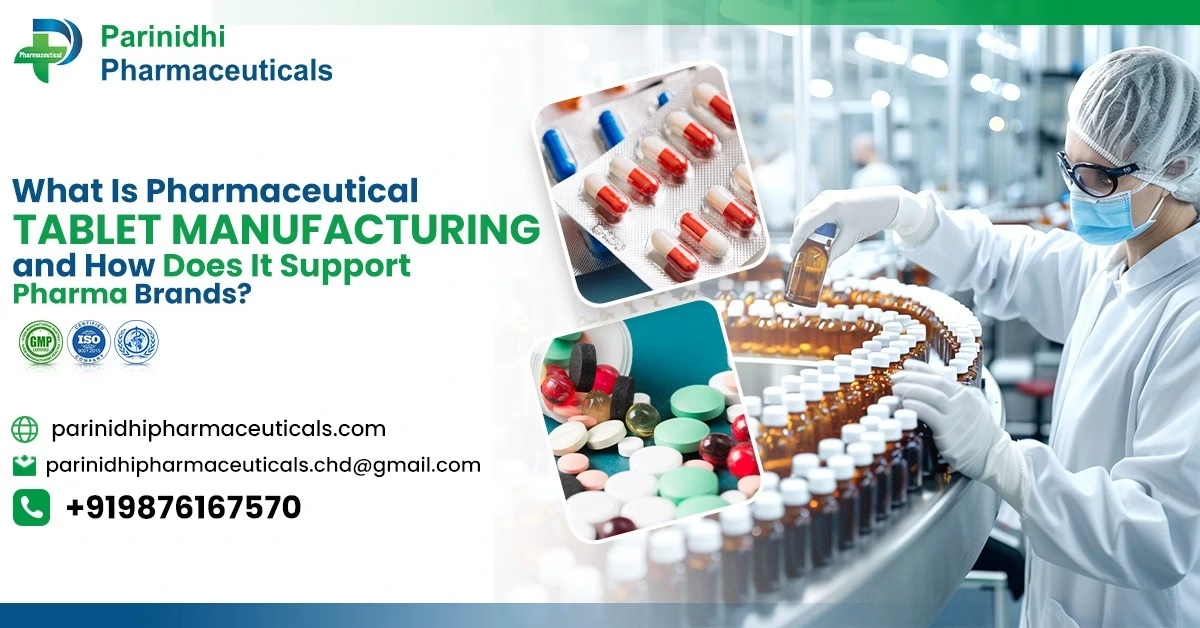
What is the best way to introduce effective medicines to Indian customers while investing minimum money? Some of the most successful healthcare brands in India have found the perfect solution to this problem by hiring professional manufacturers. In the following useful guide, we will review the key aspects of quality Tablet Manufacturing. You will learn why third-party manufacturing greatly saves your budget, minimizes risks, and increases your product distribution in India.
What is the Process of Pharmaceutical Tablets Manufacturing and Why Do You Need It?
Large pharmaceutical companies use special manufacturing facility systems for the processing of large amounts of solid oral products.
- Direct Answer: Manufacturing of solid dosage formulations is a sophisticated manufacturing process where medicines in solid form are produced through pressing.
- The Larger Picture: It ensures the stability of medicines, provides accurate chemical dosages and lowers the huge costs of branding.
- Market Environment: Engagement of an expert factory removes the need for spending millions of rupees on costly machinery. Ensuring a smooth flow of operations in making tablets will make sure that you scale up your operations.
- Key Benefit: It allows you to dedicate your efforts fully towards marketing your product and distributing it in the region.
- Strategy for Growth: Cooperation with the companies providing the bulk tablets manufacturing enables fast growth to meet seasonal demands.
- 2026 – Regulation: According to the revised Schedule M in India, manufacturing facilities for professionals offer complete traceability of the batches of medicines using the QR code system.
Contact Us for More Information: +9176579-21185
What is the process of manufacturing pharmaceutical tablets from raw chemicals?
The process of pharmaceutical tablet production changes the crude mixes of chemicals into stable and effective drugs by means of high pressure.
- First, specialists conduct tests of active pharmaceutical ingredients for chemical purity.
- Second, the heavy milling machines crush the raw materials into the same particle size.
- Third, the advanced mixers blend the base chemicals with binding food-grade agents.
- Fourth, the high-speed rotary tools press the homogeneous powder mixture into solid shapes by means of a huge hydraulic force.
- Fifth, the cores receive a protective film coating from the expert coating drums.
Such a well-organized procedure guarantees that each pressed tablet contains an identical dose of the chemical substance.
What are the Main Stages of the Process of Pharmaceutical Tablet Manufacturing?
Exact Dispensing of Material
The company workers weigh chemical components using precision digital balances. Thus, raw active chemicals become identical to the master formula sheets.
Wet and Dry Granulation
The raw powders go through the fluid-bed dryers or rapid mixer granulators. Such a process creates stable granules for proper mechanical flow. Using Third Party Tablet Manufacturing simplifies this specialized granulated processing.
High-Speed Solid Compression
Next, the prepared dry granules enter huge automatic rotary presses. After that, the hydraulic presses press the raw mixture into solid shapes. Utilizing professional tablets manufacturing protocols at this stage ensures uniform weight across millions of units.
Protective Film Coating
Having been pressed, the cores are sent to the computerized chemical spray drums. There, the thin and uniform polymer coating hides unpleasant tastes and regulates drug release.
Final Blister Packaging
At last, the high-speed lines pack the finished oral formulations into the protective aluminum blisters. This stage preserves complete freshness against external humidity.
Visit Us – First Floor, Front Side, Plot No.2A, Industrial Area Phase 2, Panchkula, Haryana 134113
Why Should Pharmaceutical Brands Choose Tablet Manufacturing for Large-Scale Expansion?
Production outsourcing makes it possible for marketing firms to expand very quickly without having to run any expensive equipment, operate any laboratories or hire any factory workers. The table that follows shows just how economically beneficial outsourcing can be.
| Operational Factor | In-House Facility Establishment | Third Party Contractual Service |
|---|---|---|
| Initial Capital Investment | High (Needs from ₹5 Crore to ₹15 Crore) | Very Low (Starts at ₹2 Lakh to ₹5 Lakh) |
| Production Speed Index | Slow (Plant Setup in 6 to 12 Months) | Fast (First Batch in 35 Days) |
| Operational Labor Overhead | Management of Permanent Staff | Handled Entirely by the Vendor Plant |
| Average Batch Cost (30,000 Units) | High Due to Machinery Maintenance Costs | Affordable (₹60,000 to ₹95,000) |
| Regulatory Risk Management | Heavy State License Renewals | No Risk (Vendor Manages WHO-GMP Norms) |
How Can Parinidhi Pharmaceuticals Help Pharmaceutical Brands Expand with Tablet Manufacturing Services?
WHO GMP-Certified Facilities
Our production facilities closely follow the international safety standards. We keep our cleanrooms always pristine to guarantee the premium purity of all batches.
High Volume Production Capacity
We use high-speed automatic rotary presses, which create thousands of units per hour. Such a huge capacity allows your brand to avoid shortages.
Economical Sourcing Rates
We help you to receive strong market margins with contractual plans starting from ₹0.80 per strip. Such a model allows you to save your investment while utilizing premier tablets manufacturing facilities.
Specialized Regulatory Team Support
Our specialists in paperwork carry out product approvals and speedy trademarking. Our cooperation with best tablet manufacturers in India makes the way much easier from the legal point of view. We cope with complex drug registration with the state perfectly.
Prompt Pan-India Shipping
We organize fast and climate-controlled shipping networks in all major states. Your commercial medicine batches arrive safely and on time.
The Bottom Line
Using the services of experienced Tablet Manufacturers in India, like Parinidhi Pharmaceuticals, allows you to simplify your supply chain, lower the initial investments and receive WHO-GMP quality. Outsourcing of your commercial tablet manufacturing will allow you to avoid complex factory operations and to concentrate only on increasing market share.
Frequently Asked Questions
Q1. What is the minimum investment for third party tablet manufacturing in India?
Ans. Introducing a new line of medicines through third-party tablet manufacturing usually requires an affordable initial investment ranging from ₹2,0,000 to ₹5,0,000. Such a sum covers your required wholesale drug licensing, trademark registrations, and initial batch production costs.
Q2. What is the cost of manufacturing commercial medicine strips?
Ans. The contract manufacturing cost of standard allopathic formulations usually ranges from ₹0.80 to ₹2.50 per blister strip of ten units. The exact cost depends on the volume of the order and the market rates of active chemicals.
Q3. How long does it take to produce an initial medicine batch?
Ans. Execution of the contract order from scratch usually takes 35 days to produce a commercial batch. Repeat batches are manufactured faster since branding artworks are already done—they take only 20 days.
Q4. What are the advantages of using professional tablet manufacturers in India?
Ans. Collaboration with professional tablet manufacturers in India allows one to avoid the need to purchase expensive industrial real estate and equipment. Brands get instant access to the certified WHO-GMP facilities with scalable volume outputs at low cost.
Q5. Why do solid pressed formulations dominate the Indian healthcare market?
Ans. Pressed oral medicines are highly stable, give accurate dosing, and keep their freshness for three years in blister packs. Besides, they are extremely economical to ship and distribute across distant markets.
Q6. What quality standards should modern medicine plants observe?
Ans. Premium facilities should strictly follow the new Schedule M rules and possess an active WHO-GMP certificate. Such standards guarantee that clean rooms are absolutely free from impurities during huge volume productions.
Q7. Is GST applicable to contract medicine manufacturing services?
Ans. Yes, standard corporate manufacturing services in the domestic healthcare industry involve the standard GST rate of 12% or 18%. The exact rate depends on the specific therapy of the solid oral medicine.
Q8. How do protective polymer coatings improve commercial . medicines?
Ans. The advanced polymer coating masks bitter chemical taste, making the product more convenient to swallow. Besides, the outer coating protects active chemicals from disintegration when exposed to ambient light and humidity.
Q9. Can small businesses order customized medicine shapes?
Ans. Yes, modern contract manufacturers can easily customize the shape, color, and scoring of your product to make your brand more recognizable. Such a unique design will protect your product from counterfeit problems in a competitive market environment.
Q10. What paperwork should be done before contract medicine production?
Ans. Your company should present its valid GST registration and active wholesale drug license. Our specialized administrative team will take care of all other technical approvals and trademark filings.