
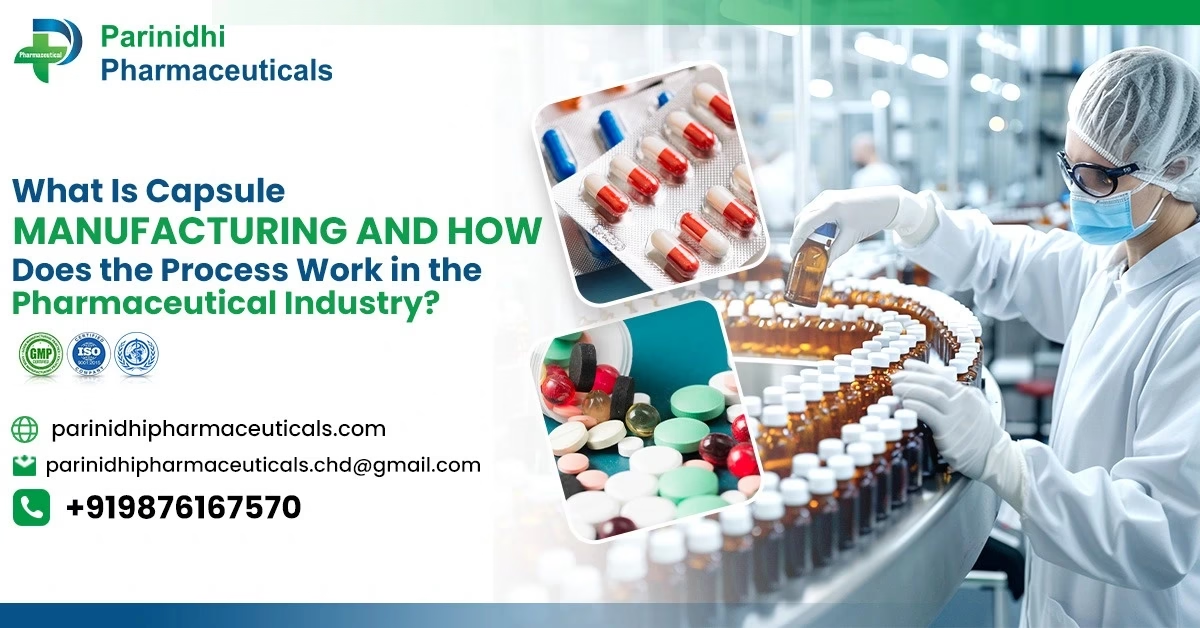
Do you want to know how raw medicinal powders are turned into neat and easily consumable capsules in your medicine storage areas? Indeed, the modern Pharmaceuticals Capsule Manufacturing industry has a highly sophisticated production system for transforming medicinal active chemical ingredients into reliable & precisely measured oral dosages. Taking into consideration modern standards of the medical sphere rapidly evolving in 2026, effective production of oral solids implies special engineering skills and clinical precision.
This blog gives you a detailed review of the technical basics, specific pharma capsule manufacturing processes and quality standards of the modern packaging industry. By learning the industrial process described below, you will get a clear understanding of how modern facilities manage to supply consumer-ready medications to the market.
Contact Us for More Information: +9176579-21185
What is capsule manufacturing and why is it so important in modern pharmaceuticals?
Pharmaceuticals capsule manufacturing is the process of enclosing the active medicinal drugs into the protective outer shell. Consequently, due to the special capsule production method, patients receive a reliable therapeutic dose of the medication in a simple-to-swallow package. Medical developers employ this approach in order to protect delicate active pharmaceutical components from such factors as moisture, light and air. Therefore, the modern medicine industry relies on such a convenient production approach.
- Modern capsule manufacturing ensures fast nutrient absorption and enhanced bioavailability.
- A protective outer shell effectively hides the unpleasant taste of complex chemical salts.
- Manufacturing units easily work with different types of active ingredients—pellets, powders, and even liquids.
- Highly automated filling equipment manages to produce up to 1 lakh capsules per hour.
- The scaled production network helps to decrease the cost of drug formulations.
- Leading Indian pharmaceutical companies use advanced polymer technology for custom shell dissolution rates.
- Strict quality standards prevent cross-contamination during batch manufacture.
Thus, a Capsule Manufacturing Company becomes an important player in stabilizing the domestic healthcare chain. Due to advanced engineering approaches, modern facilities manage to deliver premium medications to consumers.
How Does the Pharmaceuticals Capsule Manufacturing Process Work from Formulation to Final Packaging?
Step 1: Raw Material Preparation and Blending
First, medical professionals weigh the active pharmaceutical ingredients and blend excipients. Following this, the industrial blenders mix the powders so as to ensure uniformity of chemicals. This process is extremely important as it ensures that the correct amount of the drug is present in each capsule.
Step 2: Encapsulation Shells Preparation and Rectification
Secondly, empty gelatin or HPMC capsules are fed into the automatic encapsulator. A special rectification mechanism rapidly sets the capsules’ bodies and caps into correct vertical alignment. As a result, the mechanical filler is capable of separating capsules without damaging them in this stage of pharmaceutical Capsule manufacturing.
Step 3: Precise Dosing and Filling
Thirdly, the automatic filler puts blended powder/liquid into separated bodies of capsules. Highly advanced dosing disc systems guarantee the accuracy of the filling weight. After that, the machines join the filled capsule bodies and matching caps to complete the core pharmaceuticals capsule manufacturing stage.
Step 4: Capsule Polishing and Inspection
After the filling stage, the manufactured units move to a special dedusting and polishing machine. This procedure eliminates the traces of powder from the surface of the capsules. Then, high-speed optical inspection systems identify all dented or malformed units to ensure top-tier pharmaceuticals capsule manufacturing outputs.
Step 5: Blister Packaging and Cartoning
Lastly, the authorized product is directed to the automated blister packaging machine. Special machines seal the capsules in aluminum/PVC strips so that they can avoid contact with any moisture. After sealing, the strips are put into cartons, wrapping up the complete pharmaceutical capsule manufacturing line.
What Quality Standards, Testing Methods and GMP Practices Secure the Safe Capsule Manufacturing Process?
Capsule manufacturing requires strict compliance with the national and international health regulations. The table given below shows the basic quality parameters used during the process of batch evaluation in a Pharma Capsule Manufacturing facility:
| Quality Parameter | Standard Testing Method | Regulatory Implementation Cost (INR) | Industrial Purpose |
|---|---|---|---|
| Weight Variation Test | Digital Analytical Balance Testing | ₹35,000 to ₹75,000 | Guarantees the uniformity of the dose throughout the whole batch. |
| Disintegration Test | USP Disintegration Apparatus | ₹1.5 Lakh to ₹3 Lakh | Measures the time required for the capsule shell to dissolve. |
| Dissolution Analysis | HPLC and UV Spectroscopy | ₹5 Lakh to ₹12 Lakh | Checks the rate of drug release in dissolution media. |
| Moisture Content Check | Karl Fischer Titrimetry | ₹80,000 to ₹2 Lakh | Prevents brittle shell cracking and microbial contamination. |
| Microbial Limit Test | Agar Plate Incubation Method | ₹50,000 to ₹1.2 Lakh | Ensures the absence of harmful microorganisms in the finished product. |
Visit Us – First Floor, Front Side, Plot No.2A, Industrial Area Phase 2, Panchkula, Haryana 134113
Why Choose Parinidhi Pharmaceuticals for Professional Capsule Formulations?
Modern WHO-GMP Factory Infrastructure
Our facility uses state-of-the-art manufacturing plants equipped according to global standards. During pharmaceuticals capsule manufacturing, advanced machinery handles large volumes of bulk orders without the risk of contamination.
Various Product Categories
Our company offers various options for Third Party Pharma Capsule Manufacturing for various categories of therapeutic drugs. They include high-absorption softgels, antibiotic hard shells, and complex multivitamin pellet formulations.
Strict Quality Assurance Policies
Our professional laboratory checks the batches of product using advanced digital testing equipment. As a trusted capsule manufacturing company, we provide our clients with strict data transparency to protect their professional reputation.
Affordable Pricing Strategy
We offer competitive pricing to lower the initial procurement cost. Our optimized workflow allows us to provide partners with premium formulations at competitive market prices through our third party capsule manufacturing hub.
Efficient Logistics System
Our logistics department guarantees fast nationwide delivery of the products with full tracking. We offer our partners free marketing support and visual materials.
The Bottom Line
As a result, a professional capsule manufacturing process serves as an intermediary link between complex chemistry and patient treatment. This multi-stage process requires premium raw materials, high mechanical precision and laboratory analysis. For businessmen who want to expand their business, cooperation with a capsule manufacturing company helps to avoid massive investments in infrastructure.
Parinidhi Pharmaceuticals provides its customers with high-quality third-party pharmaceuticals capsule manufacturing services with a certified quality control system.
Frequently Asked Questions
Q1. How does the shelf-life of softgels differ from that of hard gelatin capsules?
Ans. Usually, the shelf life of softgels is 2-3 years if kept under refrigerated conditions. However, hard shells perform relatively better regarding their humidity resistance.
Q2. Why do the contract manufacturers opt for HPMC shells rather than gelatin shells?
Ans. Hydroxypropyl Methylcellulose (HPMC) serves as an excellent alternative for vegetarian customers. Moreover, this material contains lower moisture, which protects water-sensitive components inside the shells.
Q3. Can the pharmaceutical factory put both liquid oil and dry herbal extract into one capsule?
Ans. Indeed, modern liquid packaging technologies enable the incorporation of dry herb pellets into the oil matrix. This technology significantly enhances the bioavailability of complex combination drugs.
Q4. Which exact machine speed determines the large-scale commercial output in the modern factory?
Ans. Modern automated encapsulation lines make 80,000 to 1.5 lakh capsules per hour. Such fast production makes mass manufacturing very cost-effective.
Q5. What humidity percentage must be maintained by cleanrooms when mixing the gelatin?
Ans. Pharmaceutical cleanrooms must ensure that humidity remains between 35% and 45%. Such exact environmental conditions ensure that gelatin material is neither sticky nor brittle.
Q6. What is the primary reason for the capsule failing the dissolution test?
Ans. Often, improper chemical cross-linking of the shell material causes the retardation of the drug release rate. Generally, excess heat during the drying stage leads to this problem.